
Stem respiration estimates
We lack a detailed understanding of tree carbon flux dynamics to quantify stem respiration correctly. During my PhD, I want to understand reduced CO2 emissions from tree stems and the post-respiratory fate of CO2 in stems. I am using a novel respiration chamber system for measuring CO2 and O2 repeatedly and fully autonomous in the field. The system allows assessing the ratio of CO2 efflux to O2 influx which provides a reliable proxy for CO2 losses due to (potential) xylem flow and CO2 refixation but also for stem respiration and respiratory substrate use.

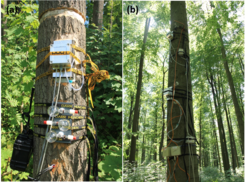
We performed (a) a girdling experiment in the Thuringian forest (cut the supply of new assimilates) in order to improve our understanding of how trees can manage carbon reserves and (b) we are interested in how (post-) respiratory processes (e.g. CO2 efflux, O2 influx, CO2 transport, CO2 refixation) change with increasing stem height in order to get an estimate of woody tissue respiration. In a next step, we want to implement those data in a recently published stem respiration model as there is a need to bring together observational and experimental data with advanced modelling approaches to get closer to actual respiration rates.