Flourishing vegetation enhances carbon dioxide variability

Überall auf der Welt registrieren Messstationen den Anstieg des Treibhausgases Kohlendioxid in der Atmosphäre. In hohen nördlichen Breiten ist allerdings noch ein weiterer Trend zu sehen: Die jahreszeitlichen Schwankungen des Kohlendioxids nehmen bereits seit den 1960er Jahren zu. Das liegt vor allem am verstärkten Pflanzenwachstum im Norden, schreiben Forscher vom Max-Planck-Institut für Biogeochemie in Jena zusammen mit Kollegen vom Potsdam-Institut für Klimafolgenforschung und aus den USA in der aktuellen Ausgabe der Zeitschrift Science. Durch die höheren Temperaturen breiten sich mehr Wälder aus, die Photosynthese verstärkt sich. So nimmt die Vegetation im Sommer mehr Kohlendioxid auf.
Das Team um die Jenaer Forscher hat damit ein kniffliges Klima-Rätsel gelöst. Denn der beobachtete Trend ließ sich mit den gängigen Klimamodellen bislang nicht reproduzieren und somit auch nicht erklären – vermutlich, weil die Modelle bestimmte Prozesse im Wechselspiel zwischen Vegetation und Klima nicht genau genug abbilden.
Seit 1958 dokumentieren Messungen am Vulkan Mauna Loa auf Hawaii, wie der CO2-Gehalt der Atmosphäre von Jahr zu Jahr ansteigt. Ursprünglich lag er bei 315 Teilen pro Million (ppm – parts per million), mittlerweile ist er auf gut 400 ppm geklettert. Die berühmte Mauna-Loa-Kurve steigt allerdings nicht gleichförmig an, sondern schwingt im Verlauf des Jahres auf und ab. Jeweils am Ende des Frühjahrs klettert der Wert auf einen neuen Höchststand. Das liegt daran, dass im Winter auf der Nordhemisphäre nur wenig Photosynthese stattfindet. Die Vegetation saugt somit monatelang kaum CO2 aus der Luft, die menschlichen Emissionen reichern sich an. Zusätzlich geben Pflanzen und Böden einen Teil des zuvor aufgenommenen Kohlendioxids durch die Atmung, bei der Kohlehydrate abgebaut werden, wieder an die Atmosphäre ab.
Mehrere Hypothesen zu verstärkten CO2-Schwankungen
„Im September fällt der CO2-Gehalt dann auf ein Minimum, weil die Vegetation auf der Nordhalbkugel den ganzen Sommer über Kohlendioxid aus der Luft aufnimmt“, erläutert Matthias Forkel, der kürzlich vom Jenaer Max-Planck-Institut zur Technischen Universität Wien gewechselt ist. Zusammen mit Nuno Carvalhais vom Max-Planck-Institut für Biogeochemie war er Hauptautor der Studie.
Die jahreszeitliche Kohlendioxid-Schwankung betrug auf Hawaii Anfang der 1960er-Jahre noch sechs ppm, inzwischen ist sie auf etwa sieben ppm angestiegen. In nördlichen Regionen war der Anstieg noch größer. So schwankten die jährlichen CO2-Werte in Barrow in Alaska Anfang der 1960er-Jahre um 15 ppm, mittlerweile liegt der Unterschied bei 18 ppm – eine Zunahme um fast 25 Prozent. Mit Hilfe von Flugzeugmessungen belegte ein Team um die britische Forscherin Heather Graven 2013, dass diese Veränderungen in nördlichen Breiten auch in etwa sechs Kilometern Höhe weiträumig auftreten.
Eine Erklärung für den Trend lieferten Graven und ihre Kollegen in ihrer Science-Veröffentlichung damals allerdings nicht. Denn in Klimamodellen trat die Zunahme nicht auf. „Es gab daher mehrere Hypothesen dazu, warum die Amplitude der Schwankung zunimmt“, sagt Markus Reichstein, Direktor am Max-Planck-Institut für Biogeochemie in Jena und Co-Autor der neuen Studie. Viele Forscher vermuteten schon damals, dass das Phänomen mit dem beobachteten Ergrünen der Arktis zu tun hat. Manche machten aber auch die intensivere Landwirtschaft mit ihren höheren Erträgen verantwortlich. Andere hielten einen Düngungseffekt durch CO2 für die Ursache.
Höhere Temperaturen lassen Pflanzen im Norden stärker sprießen
Die Jenaer Forscher wollten die Frage nun klären, indem sie Beobachtungen mit Modellrechnungen kombinierten. „Wir haben unser in Jena, Potsdam und Lund entwickeltes Vegetationsmodell anhand von Satellitendaten der letzten 30 Jahre verbessert und konnten so den Trend in der CO2-Amplitude korrekt simulieren“, sagt Matthias Forkel.
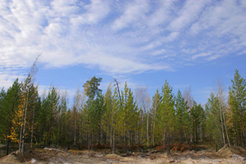
Wie sie in Science berichten, ist demnach vor allem der Klimawandel für die größere CO2-Amplitude verantwortlich: Die höheren Temperaturen lassen die Pflanzen nördlich des 45. Breitengrades stärker sprießen als früher. Die borealen Wälder breiten sich immer weiter aus. Büsche und Sträucher besiedeln die einstmals karge Tundra, und die Vegetationsperiode beginnt insgesamt früher im Jahr. All das führt dazu, dass im Sommer mehr CO2 aus der Atmosphäre verschwindet als noch vor 50 Jahren. „Die Atmung der Pflanzen und Böden hat dagegen nicht im gleichen Maße zugenommen“, sagt Matthias Forkel. Somit ist der Unterschied zwischen Sommer und Winter größer geworden.
Riesige Rückkopplungseffekte zwischen Klima und Vegetation
Die Forscher fanden zudem heraus, dass das Pflanzenwachstum im Norden kaum dadurch beeinflusst wird, dass den Pflanzen mehr CO2 zur Verfügung steht. „Die CO2-Düngung spielt in hohen Breiten kaum eine Rolle“, berichtet Markus Reichstein. Ein weiteres Ergebnis: Die Landwirtschaft trägt bei weitem nicht so stark zur Erhöhung der saisonalen CO2-Schwankung bei wie andere Forscher es zuvor berechnet hatten.
„Man sieht ganz klar, dass es riesige Rückkopplungseffekte zwischen Klima und Vegetation gibt“, so das Fazit von Markus Reichstein. Das Vegetationsmodell, das maßgeblich am Potsdam-Institut für Klimafolgenforschung entwickelt und am Max-Planck-Institut in Jena anhand von Beobachtungen getestet wird, beschreibe diese komplizierten Zusammenhänge genauer als die gängigen Erdsys-temmodelle. Es erfasst zum Beispiel besser, dass die Pflanzen früher austreiben, wenn die Tempera-turen zunehmen oder dass der Vegetation in Permafrost-Gebieten mehr Wasser zur Verfügung steht, wenn es wärmer wird.
Ob die Zunahme der saisonalen CO2-Schwankungen auch in Zukunft anhält und welche Rückwirkung dies auf die globale Erwärmung hat, lässt sich aus der Studie hingegen nicht schließen. Die Ausbreitung der Wälder im Norden hat wahrscheinlich auch negative Folgen für den Klimawandel, sagt Matthias Forkel: „Die Landoberfläche verdunkelt sich und absorbiert einen größeren Teil der einfallenden Sonnenstrahlung. Sie erwärmt sich also stärker als früher.“ Das könnte wiederum dazu führen, dass sich in Zukunft Waldbrände und Dürren häufen oder vermehrt schädliche Insekten ausbreiten. Ob der Trend zum grüneren Norden weiter anhält, ist daher unklar.
Originalveröffentlichung:
Enhanced seasonal CO2 exchange caused by amplified plant productivity in northern ecosystems
Matthias Forkel, Nuno Carvalhais, Christian Rödenbeck, Ralph Keeling, Martin Heimann, Kirsten Thonicke, Sönke Zaehle und Markus Reichstein, Science, 21. January 2016, DOI: 10.1126/science.aac4971
Kontakt
Dr. Matthias Forkel
Technische Universität Wien
Tel.: +43 58801-12229
E-Mail: matthias.forkel@geo.tuwien.ac.at
Prof. Dr. Markus Reichstein
MPI für Biogeochemie
Tel.: +49 (0)3641 57 6200
E-Mail: markus.reichstein@bgc-jena.mpg.de